
Most lawns spend spring being a lawn — cut, tidy, unremarkable. Leave one corner alone from February and it can do something far more interesting. Naturalised bulbs cost a couple of hours of autumn work and then almost nothing, and they improve year after year instead of needing replacing each season.
The catch is that not every bulb copes with grass. Some sulk, some vanish after a single spring, and a few are simply a waste of money. Here is what genuinely works in UK gardens, and how to give it the best chance.
What naturalising actually means
Planting a bulb in grass is not the same as naturalising it. Naturalising means the bulb stays put, multiplies, sets seed and slowly spreads into drifts. For that it needs three things: grass left long while its leaves are green, soil that drains, and a mowing routine built around the bulb rather than the other way round.
Mowing is the part people get wrong. A bulb's leaves are its solar panels. Cut them off in April and the bulb goes hungry, flowers poorly the following spring, then disappears altogether. The rule of thumb is six weeks of untroubled growth after flowering, and eight for daffodils. If you cannot leave a patch uncut until late May or June, pick somewhere else — or pick a bulb whose foliage dies back early, such as crocus.
The little early ones: snowdrops, crocus and aconites
Snowdrops
Galanthus are worth the effort if you have damp, humus-rich soil and light shade; the edge of a lawn beneath deciduous trees suits them well. Buy them "in the green" in February or March, lifted and replanted within a few days. Dry bulbs sold in autumn often shrivel before they establish. Plant in clumps of five to ten, 8–10cm deep, and let the grass grow until the leaves have yellowed, usually mid-May. Once a clump is crowded, lift and split it straight after flowering, while the leaves are still green, and replant immediately. Left alone for a decade, a modest patch becomes a sheet of white.
Crocus
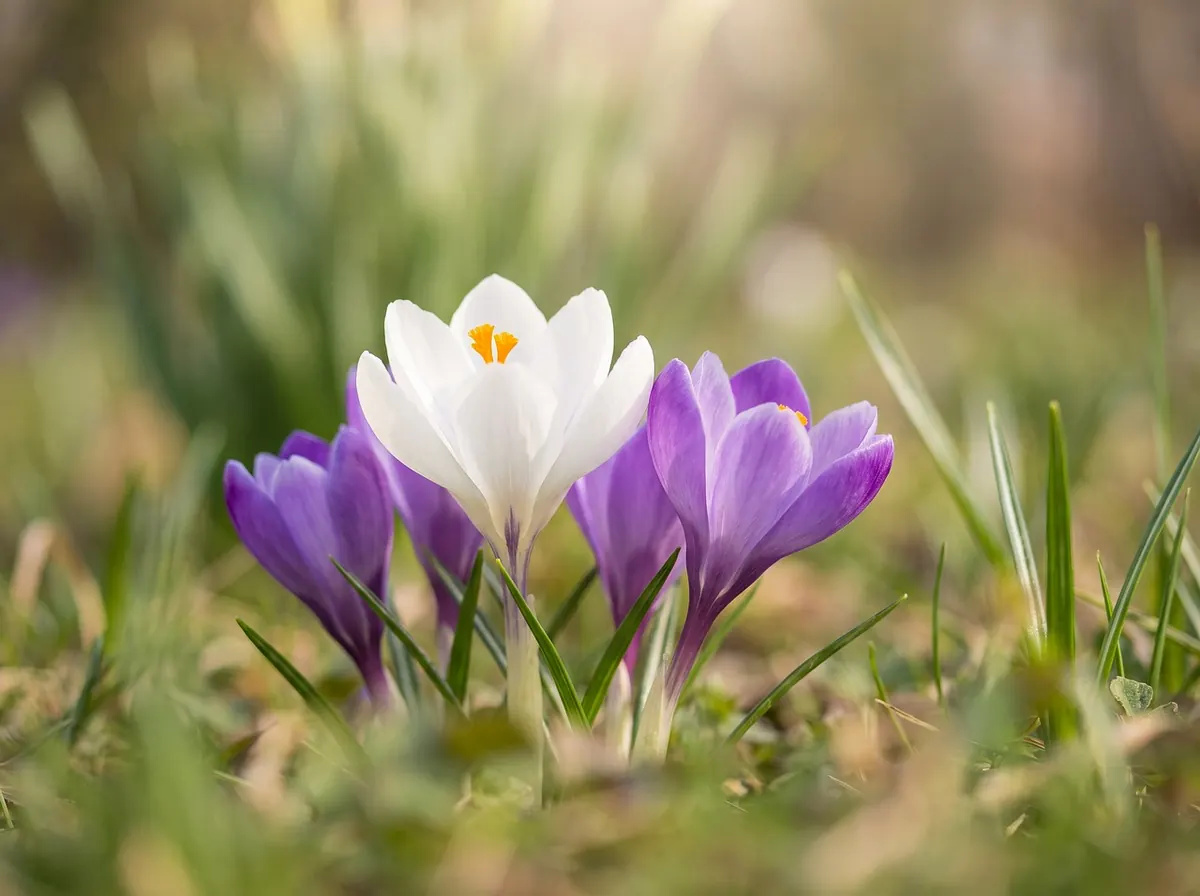
Crocus are the easiest naturalising bulb for a sunny lawn, largely because they finish early. Crocus tommasinianus is the pick for grass — smaller, cheaper and far less appealing to squirrels than the big Dutch types. Plant corms 5–8cm deep and 8–10cm apart in September or October, in fine, short grass rather than thick ryegrass, which smothers them. Foliage dies back by late April, so a single cut tidies the whole area. For a longer show, add a few Crocus chrysanthus varieties alongside.
Winter aconite
Eranthis hyemalis gives a yellow flush in February that nothing else matches, but the tubers dry out fast. Soak them overnight before planting, or buy them in the green, and put them somewhere damp and shaded. They self-seed freely once settled, though the first year or two look sparse.
Daffodils: the reliable backbone
If you plant one thing, plant daffodils. They are cheap, they shrug off squirrels, and they will still be there in twenty years. What matters is choosing the right sort. Tall exhibition varieties with heavy heads flop in long grass; look instead for small and medium types — the native wild daffodil, Narcissus pseudonarcissus, and cyclamineus types such as 'February Gold' or 'Jetfire'. Anything up to about 40cm holds its own.
Plant 10–15cm deep and roughly the same distance apart, in generous drifts rather than neat rows. Throw a handful across the ground and plant each bulb where it lands; the randomness looks far more convincing than anything you lay out by eye. Do keep in mind that all parts of a daffodil are toxic if eaten, so avoid planting them where toddlers or grazing pets will be chewing the foliage.
Expect little in the first spring. Daffodils often flower decently in year one on stored energy, then poorly in year two as they settle, before improving. By year three a drift has real weight.
Other bulbs worth a place
- Camassia — tall blue spikes in May and early June, happiest in grass that stays damp. Plant 10cm deep; it needs the longest rest of anything here.
- Snake's head fritillary (Fritillaria meleagris) — for a damp meadow corner, with chequered flowers in April. It will not tolerate soil that dries out in summer.
- Scilla and Chionodoxa — small blue bulbs for the front of a drift, planted 8cm deep. Cheap, generous and quick to bulk up.
- Cyclamen hederifolium — unusual in flowering in September and growing leaves through winter, so it wants a mowing break in autumn rather than spring. Best at the lawn edge under trees.
- Native bluebell (Hyacinthoides non-scripta) — beautiful in grass under deciduous trees, but slow from seed and it will cross with Spanish bluebells nearby. Never dig it from the wild.
What not to naturalise
Tulips are the classic disappointment. They want a hot, dry summer and generous feeding, and in grass they come back smaller each year until they stop altogether. If you love tulips, grow them in beds and lift them after flowering. Hyacinths are too stiff and formal for meadow planting, and most alliums want their foliage left intact for weeks after flowering, which is hard to square with a mowing regime. Skip the giant Dutch crocus in a rough ryegrass lawn, too — the grass wins.
How to plant a bulb meadow
- Pick a patch, not the whole lawn. A corner at the end of a border, a strip under a tree, a wide curve in front of a hedge. Anything you can leave uncut for two months without it looking neglected.
- Mow it short in early autumn and mark the area with canes or a light sprinkle of sand, so you know where to stop cutting.
- Scatter handfuls of bulbs across the patch and plant each one where it lands. Drifts beat rows every time.
- Plant at two to three times the bulb's own depth. A bulb planter is quickest in soft turf; in heavy soil, lift a three-sided flap of turf with a spade, tuck the bulbs underneath and press it back down.
- Firm the ground, water once if the weather is dry, then leave it. Autumn planting gives roots time to form before winter.
- Photograph the patch or sketch it in a notebook. In March you will not remember where anything is, and a spade through a drift is a slow way to learn.
The mowing calendar
Keep cutting normally through winter. Take one last cut in late February, before the first flowers open, and then stop. Leave the patch alone until six weeks after the last flower fades, when the leaves have gone yellow and fl
Photo: erwinbosman / Pixabay
Related posts
More stories you’ll love reading