
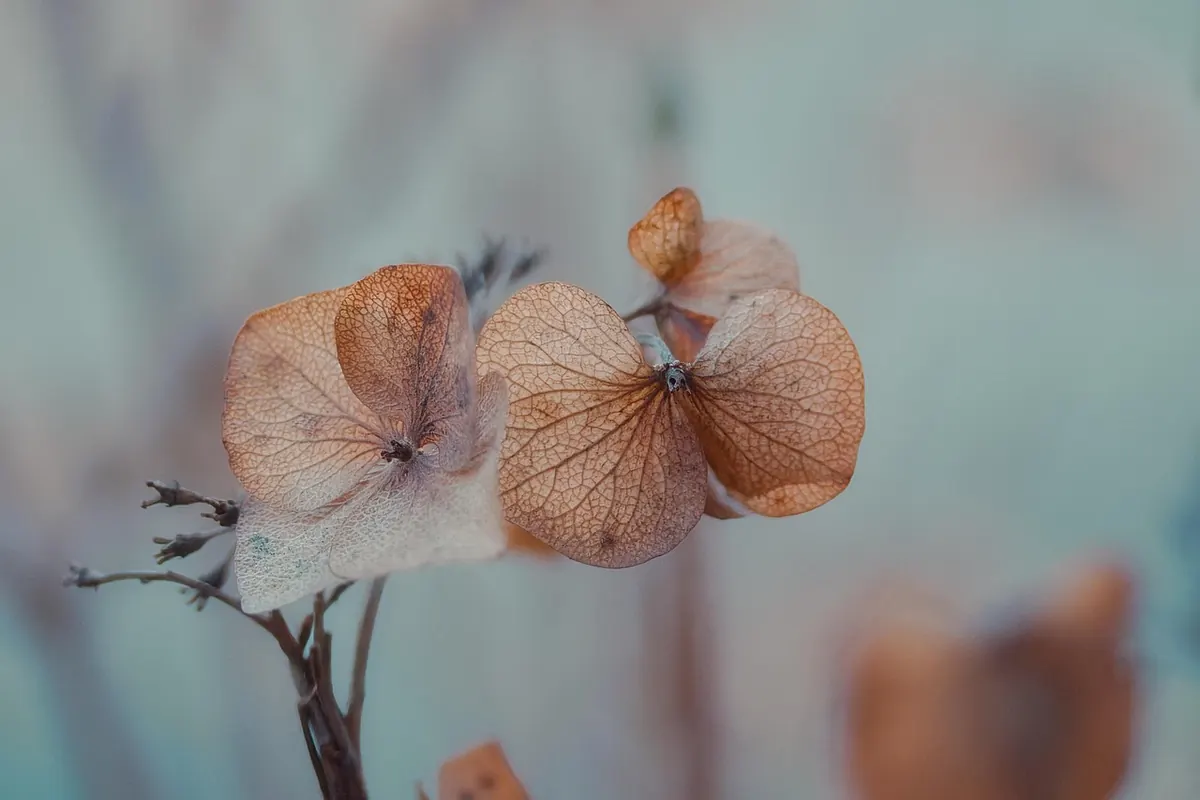
A hydrangea that opened blue in the garden centre can settle into soft pink within two seasons, and the usual explanation — that someone watered it with the wrong thing — is only half the story. The colour is not fixed in the plant. It is decided by what the roots find in your soil.
Two things govern the outcome: how acid that soil is, and whether aluminium is available for the roots to take up. Understand those and you can steer a mophead towards blue, hold it at pink, or land in the smoky purple in between.
It is worth saying at the outset that this is not a question of plant health. A pink hydrangea in chalky soil is not struggling; it is simply reading the ground it is planted in. The colour is a report on your soil chemistry, written in petals.
What is actually happening underground
The pigments in a hydrangea flower belong to the anthocyanin family, the same broad group that colours blueberries and red cabbage. Left alone they read pink. When they bind with aluminium ions drawn up from the soil, the pigment molecule shifts and the flower appears blue. No aluminium, no blue.
Aluminium is present in almost every soil in Britain. What varies is whether it is soluble. In acid conditions, roughly below pH 5.5, it dissolves readily and the roots can absorb it. As soil moves towards neutral and alkaline, around pH 6.5 and above, it locks onto soil particles and becomes unavailable. The plant does not stop wanting it; the soil stops supplying it.
So pH is not the cause of the colour. It is the switch that controls the cause. The amount a hydrangea takes up is tiny, and a healthy plant manages it without trouble. In fact hydrangeas are unusually tolerant of aluminium — many garden plants would be poisoned by concentrations a hydrangea shrugs off and turns blue over.
Why the same plant looks different in two gardens
Take two divisions from the same 'Nikko Blue' and plant one in a Cornish valley and the other on the chalk downland of Hampshire, and within three years you will have two plants that barely look related. The Cornish ground is likely to be acid and leached by heavy rain; the Hampshire soil is thin, alkaline and full of free lime. Same genetics, different chemistry.
This is why a neighbour's confident advice can be useless. Their soil is not your soil, and the only reliable starting point is a measurement.
Which hydrangeas change colour — and which never will
The colour-changing trick belongs almost entirely to Hydrangea macrophylla, the species behind the familiar mopheads and lacecaps, and to its close relative H. serrata, which includes the daintier lacecaps such as 'Bluebird' and 'Preziosa'. If you grow one of those, pH is worth thinking about.
Everything else in the genus ignores the question:
- Hydrangea paniculata — 'Limelight', 'Vanille Fraise', 'Grandiflora'. These open white or cream and fade through pink to a dusty rose-brown in autumn regardless of what the soil is doing.
- Hydrangea arborescens — 'Annabelle' and its relatives. White, then a soft lime-green as the flowers age.
- Hydrangea quercifolia — the oakleaf. Creamy white panicles that turn pink and bronze alongside the foliage.
- Hydrangea aspera and its hybrids — lacecap flowers in white or palest lilac, quite unaffected by pH.
- White mopheads such as 'Madame Emile Mouillère'. White hydrangeas stay white. They do not carry the pigment that responds to aluminium, so no amount of treatment will shift them.
Even within the changeable macrophylla group, some varieties have a narrower range than others. Deep reds and near-whites hold their ground more stubbornly; the reliably changeable ones tend to be the clear pinks and blues. If in doubt, buy a plant in flower and note the colour you were sold — that tells you what the nursery's soil was doing, not what yours will do.
Test before you treat
Guessing is the most common mistake. A cheap soil pH kit from a garden centre, or a simple probe meter, will tell you more in ten minutes than a whole season of trial and error.
- Take several samples. Dig a small amount from 10–15cm down in three or four spots around the plant and mix them together.
- Test damp soil, not dry. Most kits are calibrated for moist samples.
- Note the reading. Below 5.5 means blue is realistic. Above 6.5 means pink is the natural outcome. Between the two, you are in purple territory.
- Repeat in another bed. pH can swing sharply over a few metres, especially where builders' rubble, old mortar or a concrete path has leached into the ground.
If you would rather not buy a kit, watch what already grows. Rhododendrons, camellias, heathers, bluebells and sheep's sorrel point to acid ground. Lavender, buddleia, scabious, sea holly and cranesbill geraniums suggest something neutral to alkaline.
Colour in a hydrangea is not a variety trait. It is a soil test you can read from the kitchen window.
How to push a hydrangea towards blue
Blue needs two conditions at once: acid soil and available aluminium. Acidifying alone will not do it if the aluminium is locked away, though in most British soils acidifying releases what is already sitting there.
- Lower the pH with sulphur. Flowers of sulphur, worked into the soil around the drip line in late winter, acidifies slowly and gently. Follow the packet rate — more is not faster, and it can scorch roots.
- Add organic matter. Leaf mould, composted bark and ericaceous compost improve structure and help hold acidity in place.
- Use aluminium sulphate with care. It is the traditional bluing treatment and it works, but it is a salt. Overuse damages roots and accumulates in containers. Stick to the low end of the recommended rate, and only on established plants.
- Water with rainwater. In hard water areas, every watering with tap water adds lime and quietly undoes your work. A water butt is worth more than any bottle of tonic.
- Mulch with bark or pine needles. Modest but cumulative, and it keeps the root zone cool and moist.
Expect the change in the following season's flowers, not the ones already open. Buds form the previous year, and their pigment load is decided long before the bloom appears.
How to hold a hydrangea at pink
Pink is the default in neutral and alkaline ground, so if your soil is already chalky there is little to do but keep it that way. If your soil is acid and you want pink, you need to raise the pH:
- Garden lime or ground limestone. Apply in autumn or early spring at the rate on the pack, and retest each year rather than topping up blindly.
- Wood ash. A light dusting raises pH and adds potassium. Keep it clear of the stems and never use ash from treated or painted timber.
- Hard tap water. On acid ground in a hard water area, watering from the tap works gently in your favour.
Go slowly. Over-liming locks up iron and other nutrients and produces yellow, sickly leaves — a far worse problem than a flower of the wrong colour.
Why the UK makes this awkward
British soils are unusually patchy over short distances. Much of the south-east, the Chilterns, the Cotswolds and large parts of Lincolnshire and Yorkshire sit on chalk or limestone, which buffers soil firmly towards alkaline. Wales, Scotland, the Pennines, the West Country and most heathland are acid and often leached. A single garden can straddle both where a house was built on made ground.
Water hardness compounds it. London and the south-east have among the hardest tap water in the country, and a summer of watering can push a container from pH 5.5 towards 6.5 within a season. Pots suffer most, because there is no soil reserve to buffer the change.
If you grow hydrangeas in containers, the practical answer is to repot every two or three years — into fresh ericaceous compost for blue, or a loam-based compost with a little lime for pink — and to use rainwater wherever possible.
The middle ground, and the limits of control
Between roughly pH 5.5 and 6.5, a single plant can carry blue, pink and purple flowers at once, with the deepest colour usually on the youngest wood. Many gardeners find this the most attractive result of all, and it is honest about the soil you actually have.
Two things are worth accepting. First, you cannot turn a white hydrangea blue. Second, you cannot change a plant overnight, and heavy-handed treatment will cost you leaves and roots long before it costs you a petal. Aim for a gentle nudge over two or three seasons and let the soil settle around it.
Get it right, though, and the reward is quietly satisfying: a plant that tells you, every July, exactly what is going on under your feet.
Photo: HeiKiwi / Pixabay
Related posts
More stories you’ll love reading